- SPP’s CHILL pathway is worth publishing now because the useful signal is not simply that one regional grid operator has another large-load program.
- The official materials are specific enough to matter.
- The structure gets more meaningful in the underlying tariff filing.
- Section
- Energy
- Read time
- 5 min read
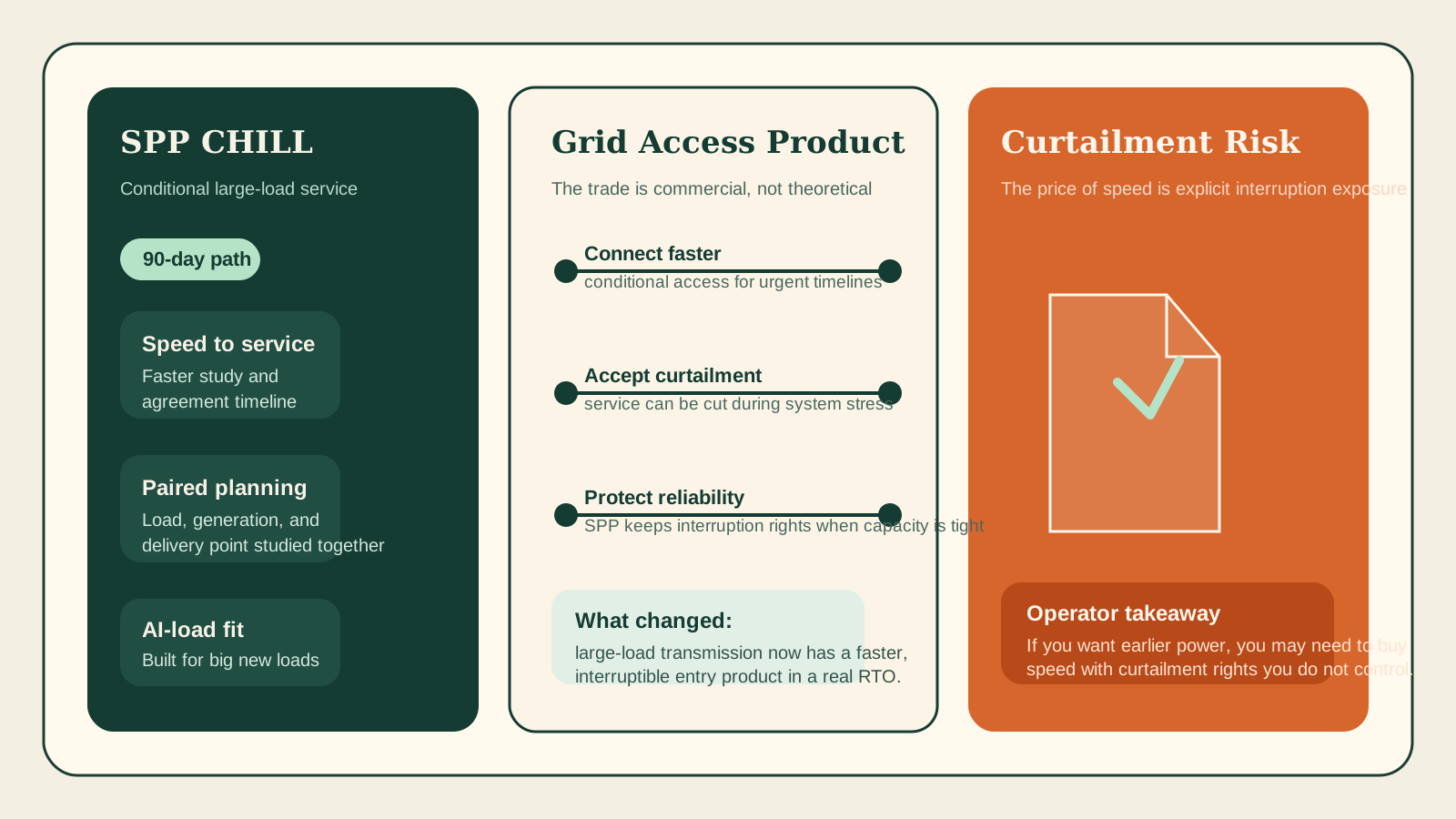
SPP’s CHILL pathway is worth publishing now because the useful signal is not simply that one regional grid operator has another large-load program. The stronger signal is that AI-era grid access is being turned into an explicit product with a visible tradeoff. If a hyperscale campus wants power faster, the price may be accepting curtailment rights that the grid operator can use when the system is stressed. That is a more concrete and operator-relevant shift than another broad debate about queues or load forecasts.
The official materials are specific enough to matter. On its High Impact Large Load page, SPP says its proposed solutions include Conditional High Impact Large Load service, or CHILL, and says the new process can deliver a clear path to interconnection agreements within 90 days. SPP also says CHILL gives customers with urgent timelines conditional access to the grid, with the tradeoff of potential curtailment during periods of system stress to protect regional reliability. That is the publishable detail: speed is no longer being offered as if it were free.
SPP’s useful signal is that faster AI-scale grid access is no longer being offered as if it were ordinary firm service. It is becoming a curtailment-for-speed bargain.
The structure gets more meaningful in the underlying tariff filing. In SPP’s February 10 submission to FERC, the grid operator says the United States is seeing an unprecedented surge in large-load requests driven significantly by AI data centers, crypto mining, electrified industry, and other high-demand facilities. SPP argues that these concentrated loads strain transmission planning, real-time operations, and resource-adequacy processes that were built for slower and more distributed demand growth. CHILL is its answer for projects that want a faster path than ordinary firm service can currently offer.
That is why this clears the duplicate block against the site’s recent PJM, PPL, and FERC large-load coverage. Those stories were about cost allocation, governance, or the possibility that projects may need to bring supply with them. SPP’s CHILL framework is narrower and more commercial. It turns large-load transmission access into a defined bargain: quicker study and earlier service if the customer accepts that reliability rights stay firmly with the grid operator.
For operators and developers, the practical implication is straightforward. “Speed to power” is becoming something you may have to buy with operating flexibility, not just with higher capex or better land. A developer using CHILL is not simply reserving capacity. It is agreeing that the load may be interrupted under defined conditions if the grid needs the headroom. That shifts diligence earlier into the site-selection and financing process because uptime assumptions, backup design, customer contracts, and economics all need to account for that interruption profile.
For investors, the stronger read-through is that not all powered-land claims should be valued the same way. A site with a conditional transmission path is economically different from one with ordinary firm-service expectations, even if both are described as moving quickly. The useful question is no longer just whether a project got a grid path. It is what kind of grid path it got, on what timeline, and with whose curtailment rights preserved.
For policymakers and other RTOs, SPP is also offering a live model for how to absorb AI-scale demand without pretending the old service menu still fits. In January, FERC accepted SPP’s HILL and HILLGA processes as a just and reasonable way to identify and study high-impact large loads and associated generation while protecting reliability. CHILL extends that logic from study design toward commercial structure. The direction of travel is clear: the system is moving toward more explicit large-load contracts rather than vague assumptions that every new campus can arrive on ordinary terms.
The Grid Report view is that this story clears the search bar because it answers a specific question better than a generic transmission headline: what is SPP’s CHILL service actually doing? The useful answer is that it formalizes a new AI-era grid-access bargain. If a project wants a faster path to interconnection, it may have to accept curtailment risk as part of the price of speed.
Sources
Southwest Power Pool, “SPP’s High Impact Large Load Interconnection Solutions: Powering Growth, Accelerating Opportunity,” accessed June 9, 2026: https://spp.org/markets-operations/high-impact-large-load-hill-integration/
Southwest Power Pool, “FERC approves SPP’s large load connection proposal,” published January 15, 2026: https://www.spp.org/news-list/ferc-approves-spp-s-large-load-connection-proposal/
Southwest Power Pool, “Revisions to Add the Conditional High Impact Large Load Service,” filed February 10, 2026: https://www.spp.org/documents/75954/20260210_revisions%20to%20add%20the%20conditional%20high%20impact%20large%20load%20service_er26-1323-000.pdf
Federal Energy Regulatory Commission, “Commissioner Rosner’s Concurrence to Order Accepting Tariff Revisions, Subject to Condition re Southwest Power Pool, Inc. under ER26-247,” published January 14, 2026: https://www.ferc.gov/news-events/news/commissioner-rosners-concurrence-order-accepting-tariff-revisions-subject
By Nawaz Lalani
The Grid Report is written by Nawaz Lalani and focuses on source-backed coverage of AI infrastructure, grid power demand, automation systems, and market signals.
Follow the signal, not just the headline.
Get the daily Grid brief for source-backed coverage on AI power demand, infrastructure timing, automation, and market signals.