- Microsoft’s Nevada tariff filing is worth publishing now because the useful signal is not simply that another data-center developer says it wants to protect ratepayers.
- The official docket record establishes the timing.
- The most useful details come from the structure described around the filing.
- Section
- Policy
- Read time
- 5 min read
- Why this page exists
- The Grid Report publishes operator-grade coverage on AI, power, infrastructure, automation, and markets.
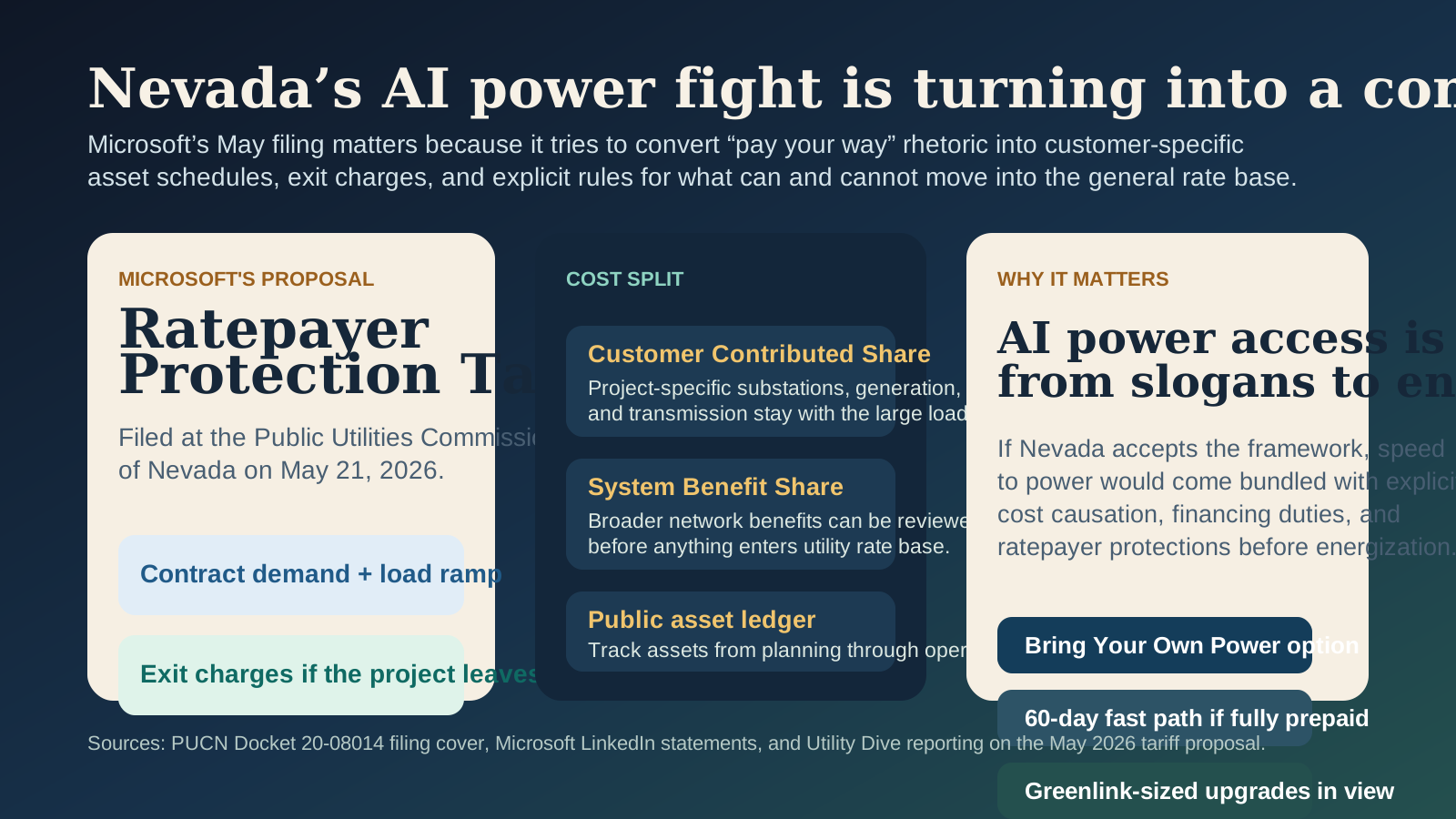
Microsoft’s Nevada tariff filing is worth publishing now because the useful signal is not simply that another data-center developer says it wants to protect ratepayers. The stronger signal is that AI-era power access is being rewritten as a contract-design problem. Instead of leaving “pay your way” as a political slogan, Microsoft is proposing a framework that tries to specify who funds project-specific assets, which benefits can ever be socialized, and what happens if a large load scales slower than promised or exits early.
The official docket record establishes the timing. The cover page for Microsoft’s filing in Public Utilities Commission of Nevada Docket 20-08014 shows the comments were submitted on May 21, 2026, on behalf of Microsoft Corporation. Public Microsoft statements after the filing describe the proposal as a Ratepayer Protection Tariff, or RPT, and say its core principle is that large-load customers should be accountable for the full cost of the electric service required to support their operations.
The useful Nevada signal is not that Microsoft says it will pay its way. It is that AI power access is being turned into a contract architecture with explicit cost causation before the campus is energized.
The most useful details come from the structure described around the filing. Utility Dive reported on June 8 that Microsoft’s proposal splits new infrastructure into a Customer Contributed Share and a System Benefit Share. In that framework, NV Energy would identify and track substations, generation, transmission, and related facilities needed for a specific large-load project on a customer-specific asset schedule. The customer would fund the project-specific share directly, while any broader network value would still have to be reviewed before it could move into utility rate base.
That is why this clears the duplicate block against the site’s recent “who pays,” PPL LP-6, Oregon Schedule 96, and New York moratorium coverage. Those pieces were about regulators or lawmakers designing general rules around large-load growth. Nevada is different because a hyperscale customer is volunteering a more explicit commercial structure for its own category of demand. The angle is narrower and more operator-relevant: AI power is being negotiated not only through tariffs, but through customer-specific cost-allocation contracts that utilities can actually plan around.
For operators, the practical implication is that speed to power may increasingly require more than land control and a utility conversation. It may require a financeable service structure with contract demand, load-ramp obligations, customer-funded assets, and a defined end-of-life or exit-charge regime. In other words, grid access starts to look less like ordinary bundled retail service and more like a negotiated infrastructure product.
For utilities and investors, the stronger read-through is that large-load economics are becoming ledger-based. Once a utility is asked to track customer-specific substations, transmission facilities, and generation support assets from planning through operation, AI demand becomes easier to price, finance, and scrutinize. That can reduce cost-shifting ambiguity, but it also makes clear which projects are only viable if somebody else absorbs part of the bill.
The proposal is also notable because it appears to make room for faster and more flexible buildout. Utility Dive reported that Microsoft’s filing includes a Bring Your Own Power option and a fast-track review path for projects fully funded up front by developers, while Microsoft-linked public statements say the objectives are to protect existing customers, give utilities planning certainty, and enable safe growth. That combination matters because it suggests the next policy frontier is not simply whether AI projects should pay more. It is how to let them pay more in a way that actually shortens the path to energization.
The Grid Report view is that this clears the search bar because it answers a live and specific question better than a generic tariff headline: what changed in Nevada? The useful answer is that a major AI-load customer is trying to turn ratepayer-protection rhetoric into a contract architecture, where customer capital, utility planning, and grid-expansion risk are all assigned before the next power-hungry campus plugs in.
Sources
Public Utilities Commission of Nevada, Docket 20-08014 filing cover showing Microsoft Corporation comments submitted May 21, 2026: https://puc-onbase.nv.gov/api/Document/AWz9IczTI%C3%89LfrL7c78cfRFhFdYsZBmGLajQ0yNTahJbR%C3%89JrMDax4yAMt9AlQlOju%C3%817TX8hs63%C3%893TEZ1b2%C3%89pdAeU%3D/?OverlayMode=View
Matthew Fox, Microsoft, “Microsoft’s Comments in Docket No. 20-08014,” LinkedIn post, accessed June 9, 2026: https://www.linkedin.com/posts/matthew-fox-2b295594_microsofts-comments-in-docket-no-20-08014-activity-7463625863843168256-1Mhi
Jeff Riles, Microsoft, “Microsoft Proposes Ratepayer Protection Tariff for Large Load Tariffs,” LinkedIn post, accessed June 9, 2026: https://www.linkedin.com/posts/jeffriles_microsofts-ratepayer-protection-tariff-activity-7465800212087930880-oIf0
Utility Dive, “Microsoft seeks Nevada tariff to shield ratepayers from data center costs,” published June 8, 2026: https://www.utilitydive.com/news/microsoft-seeks-nevada-tariff-to-shield-ratepayers-from-data-center-costs/822250/
Nawaz Lalani
Nawaz Lalani is the creator of The Grid Report and writes about AI infrastructure, grid power demand, automation systems, and the market signals shaping the physical AI economy. His focus is translating technical and industrial shifts into practical coverage for operators, investors, builders, and teams making real deployment decisions.
B.S. in Geology from UT Arlington. Covers AI infrastructure, energy systems, grid constraints, automation workflows, and market signals.
Stories are built from primary sources, utility and infrastructure signals, company disclosures, filings, and operator-grade context. The goal is to explain what changed, why it matters now, and what it means for builders, investors, utilities, and teams making real deployment decisions.
Follow the lane, not just the headline.
The strongest value in The Grid Report comes from following how AI, infrastructure, power, automation, and markets connect over time.